JuhaGallery.com


The Psychology of Art
It appears that perception of pictures is not an innate skill, we have to learn it. My interest in representational art goes into my training as a behavioural scientist on memory, cognition, and, more specifically, in perception of art. I believe that vision and thought are inextricably linked. Thinking is not purely verbal, but as any artist can tell, they can think in images patterns and colors. I have come to believe that thinking is at basic level quite abstract and takes expression in verbal, visual, tactile forms much like deep structure and surface structure of language (Noam Chomsky). Also, as a musician and composer, there may be a synesthetic effect happening ... for example, when I look at pictures, they can easily become music, and music, in turn, becomes colors, patterns, and timelines. It's all very precious and I plan to write more about it in my blog. Juha (John) Kumpunen, M.A.
Percpetion of pictures is not innate, it is a learned skill.
Abstract art is a kind of Rorschach test? Abstract art's greatest demand—and gift—is its radical openness.
There are significant cross-cultural differences in people's skills to perceive and to understand pictures.

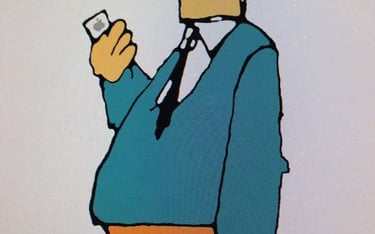




I wrote my Masters thesis at the University of Toronto on the speed of recognition from photographs, line drawings, and cartoons based on a 1956 for study by Ryan and Schwartz, where they found that when “unnecessary” information is removed from drawings, as in cartoons and caricatures, and the only visual information is (outlines) salient features, recognition of an object is faster. I drew shaded line drawings, line drawings, and cartoons of common objects and presented to subjects in a tachistoscopic experiment (where the object is displayed only for milliseconds and the subject has to respond. “Is this a bear … yes … presses button”). It seems our perceptual system is so immensely sophisticated that I was not able to demonstrate any significant benefit of reducing the visual information in the image, at least for university students in a western culture where perceptual learning has taken place over decades.
This finding is in sharp contrast to anthropological studies that show that people in some cultures are unable to decipher and understand the meaning of photographs and line drawings. For example, South African psychologist W Hudson conducted studies with Bantu children who were not able to recognize a 2-D version of a object as displayed in a drawing. Hudson concluded that understanding pictorial depth cues is culturally learned. Similarly, Zdravkovski 1972 suggested in his study that cultures with little pictorial tradition, lack a pictorial schema a mental framework for interpreting 2-D representation as 3-D objects. They see the lines and shapes literally, not as symbolic, extend it for real world objects.
Perhaps more interestingly, and touching on the interesting topic of visual thinking (cf., Rudolph Arnheim, Visual Thinking, 1969), the perception of abstract art could be viewed as a kind of collective, public Rorschach test might be a considered as a compelling framework for understanding why some abstract art is more appealing than others. Here the assumption is that the more ascribed meaning, the more appealing the piece of art is.
The Core Analogy: Projection and Interpretation
The Rorschach Test: Relies on ambiguous inkblots with no inherent representational meaning. The psychologist is less interested in the "correct" image and more in the process of perception—what the viewer projects onto the blurry forms based on their inner world (fears, desires, cognitive patterns).
· Abstract Art (especially non-representational): Removes the familiar anchor of a recognizable subject (a person, a landscape). Faced with a canvas of shapes, colors, textures, and lines without a prescribed narrative, the viewer's brain instinctively tries to make meaning. This meaning-making process is heavily influenced by personal psychology
more to come ...
Substantial anthropological and psychological research from the mid-20th century confirms that people from cultures with no tradition of pictorial art (particularly line drawings and photographs) initially struggle to recognize or make sense of these images. They do not spontaneously see a photograph as a "likeness" or a line drawing as an "object." This ability is a culturally acquired skill, not a universal human trait. The most famous examples come from work in sub-Saharan Africa (Ethiopia, South Africa) and Oceania (Papua New Guinea).
Key Theoretical Concepts from This Research:· • • Perceptual Learning: The brain must learn to interpret specific visual cues. In cultures without pictures, this learning doesn't occur naturally.
· Carpentered World Hypothesis: People from cultures with abundant right-angled buildings (the "carpentered world") are more conditioned to interpret 2D perspective drawings as 3D spaces.
· Picture Primacy: In Western cultures, we are so immersed in pictures from infancy that we forget it's a learned code. This research is a powerful reminder of that.
Deregowski, J.B. (1980). Illusions, Patterns and Pictures: A Cross-Cultural Perspective.
Hudson, W. (1960). "Pictorial depth perception in sub-cultural groups in Africa."
Kennedy, J.M., & Ross, A.S. (1975). "Outline picture perception by the Songe of Papua."
Segall, M.H., Campbell, D.T., & Herskovits, M.J. (1966). The Influence of Culture on Visual Perception.